
From urban interventions to bodily actions, DeCiDe fosters critical action, social innovation, political experimentation, and radical imagination to contribute to the material, sociocultural and political construction of the city and the lived environment.
Design-City-Democracy (DeCiDe)
DeCiDE is a Research through Design line that explores the intersection between design and the lived environment, fostering a forward-thinking political agenda.
Coordinator: Roger Paez, PhD
Topics
1. Architectures
2. Activisms
3. Critiques
4. Changes
Alternative and emergent forms of architecture and the transformative impact of situated spatial design practices.
Place-based politics through the design of performative assemblages, advocacy and experimentation through transdisciplinary actions.
Design principles, ethics and critical theories.
Design of socio-cultural change, including both situated-pragmatic practices and speculative-fictional approaches.
Working at all scales and across disciplinary limits, harnessing both physical and digital tools and technologies, DeCiDe investigates the spatial, material, temporal, narrative, and relational architectures that define the lived environment and explores the diverse roles of design as a worldmaking agent to foster socially, culturally and environmentally sustainable habitats. Its research object is the human and more-than-human habitat. Its ethos is critical, progressive, and exploratory. Its field is an expanded understanding of design with an emphasis on environmental sustainability and social change.
Design-City-Democracy (DeCiDe) mainly focuses on:
- Critical design and sociopolitical impact, and to a lesser extent
- Inclusive, feminist society, with universal quality public services, equal rights, and universal access to culture and sport
- Security, digital transformation and public services.
DeCiDe addresses disciplinary siloes, difficulty articulating academic research and citizens’ interests, insufficient accountability, political disaffection, loss of imagination, lack of criticality, authoritarianism, and regressive politics.
By working on interventions, prototypes, structures, public actions, community agency proposals designed-with/tested by/with communities it seeks to achieve enhanced community action, advocacy support, changes in governance, policy change/adaptation, and generally foster critical design’s social, cultural, and political impact in the lived environment.
Members of this research line are:
Dr. Roger Paez (Coordinator), Dr. Danae Esparza Lozano, Dr. Ariel Guerszenvaig, Dr. Manuela Valtchanova, Dr. Daniele Porretta, Dr. Guim Espelt Estopà, Dr. Ramon Faura Coll, Dr. Daria de Seta, Dr. Paolo Sustersic, Dr. Saúl Baeza Argüello, Dr. Raul Goñi Fernandez, Dr. Enric Llorach Herrero, Toni Montes Boada, Alberto Imberti.
Projects
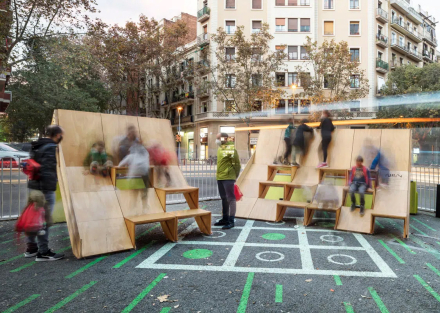
Key innovations and technology transfer projects address social innovation by generating new quality interactions amongst citizens thanks to temporary space designs and tactical urbanism actions, and address sustainability by developing circular sustainable urban furniture.