
Merch Intervention: Five Alumni Perspectives Activating the Elisava Archive
On the occasion of Elisava’s 65th anniversary, the exhibition Merch Intervention offers a contemporary reading of the school’s archive through the transformation of a piece of merchandise created specifically for the celebration. Five alumni were invited to reinterpret this object through personal interventions that connect their current practice with the institution’s collective memory.
Each intervention serves both as an expression of its author’s creative language and professional trajectory, and as a new document that becomes part of the Elisava Archive. Together, the works create a dialogue between past and present, reaffirming the archive as a living space for memory, production and collective projection.
Nicolás Barreto’s proposal, created through screen printing, reflects on digital naming systems and the evolution of meanings associated with technology. Taking Adobe Illustrator’s unique abbreviation, “Ai”, as its starting point, the project explores the coincidence between the software’s historical initials and their current association with artificial intelligence. The piece connects different technological moments and examines how meanings shift over time.


Manuel Montard – Untitled
Manuel Montard’s intervention reverses the conventional production process, returning the garment to a state close to its material origin. By wearing away the sweatshirt’s fabric, the artist extracts its fibres, cards them by hand and transforms them back into yarn using a traditional spindle, finally presenting the resulting thread wound around wooden bobbins.
The work reflects on craftsmanship, transformation and the relationship between past and present. It questions conventional notions of evolution and linear progress while opening up new ways of understanding material processes and their potential to generate future possibilities.


Starting from the question, “What now?”, Aitana Solivas brings the sweatshirt into the realm of printmaking. By passing the garment and a sheet of paper through an engraving press without ink, the pressure leaves behind an embossed imprint of the piece.
The work draws a parallel with the educational experience: years of study become a first layer upon which new interests, paths and aspirations are built. Although academic life is a finite period, the marks it leaves endure and become part of everything that follows.


Dr. Gastón Lisak – Too Beautiful to Be True
Too Beautiful to Be True reflects on the growing distance between appearance and material reality. At first glance, the installation appears to be an exuberant floral arrangement. A closer look, however, reveals the flowers’ artificial nature: imitations of nature that have never actually been part of it.
Through this contradiction, the work questions the role of design in a world increasingly populated by materials and objects that simulate other realities: surfaces that resemble marble, laminates that imitate wood, or digital images that are becoming increasingly difficult to distinguish from photographs.
Rather than rejecting artificiality, the piece raises a question about the responsibility of design in constructing these illusions. Should design make things look like something they are not, or can it encourage a more honest relationship between materials, objects and their environment?
Created as part of Elisava’s 65th anniversary, the intervention transforms a commemorative object into a device for reflecting on materiality, representation and memory. After the exhibition, the work will become part of the Elisava Archive, preserving, paradoxically, a collection of flowers that have never been alive.


Júlia Esqué – Intervention
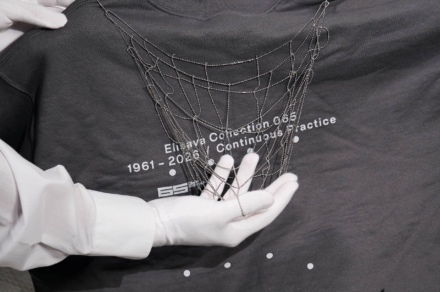
Júlia Esqué’s proposal incorporates a continuous stainless steel ball chain threaded through perforations made in the white circles of the sweatshirt’s original graphic print. Because the chain moves freely within the garment, it can be pushed or pulled to alter the visible curves and loops on the surface, continuously transforming its shape.
The intervention continues the material research developed by the designer in projects such as Mesh Vessels, where she explores lightweight, flexible and almost transparent structures. In this case, the chain forms a hood that falls down the back and ties at the front, adapting to the body and altering the garment’s original form. The result is a dynamic piece that turns the object into an open system for transformation and interaction.


The merchandise collection created to celebrate Elisava’s 65th anniversary will soon be available on the school’s website. An opportunity to celebrate this milestone and take home a piece that is part of the history, present and future of the Elisava community.


