
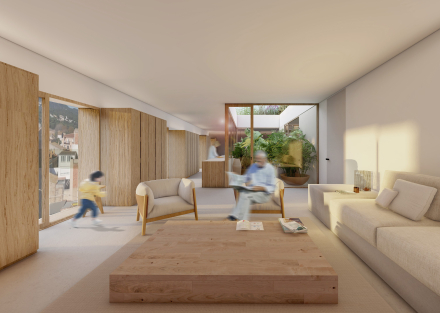
What profile of designers is currently making a positive impact in the professional field of interior design and architecture?
This Master’s Degree in Interior Design arises from an in-depth analysis of today’s professional and social context, which demands interior designers with a comprehensive education who are capable of addressing complex projects that explore the hybridisation of living, residential and working spaces, as well as other spaces linked to culture, leisure, or knowledge.
In this master’s program, we understand interior design as a discipline in constant evolution, currently driven by an increasing prioritisation of user-centred design. This approach considers users’ functional, vital, and cultural needs and translates them into the design of spaces and the selection of materials, with a particular emphasis on their well-being.
Unlike other programs, this master’s not only enhances the usual skills of designers as the main creative agents who give unique identity to spaces, but also aims to train professionals capable of managing and mastering the design of interior spaces in their entirety. This approach includes both interior architecture and interior design, integrating visible and non-visible systems. These design principles involve the use of meaningful materials, both for their identity and their low environmental impact or contribution to the passive performance of spaces, understanding construction systems, emphasising spatial conditions related to comfort (lighting, mobility, temperature, acoustics…), and keeping up-to-date with technological solutions applied to space and its operational strategies.
Admission requirements:
Official university degree or equivalent. Knowledge of graphic representation software for architectural space.


