
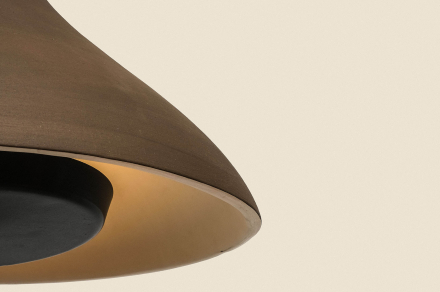
At the intersection of a passion for design and a commitment to sustainability emerges the figure of Àlex Jiménez, Alumni and founder of NutCreatives, now driving Suru alongside Ricardo Camilleri, an innovative venture in furniture and lighting design. With a solid background in product design and development, Jiménez and his team found themselves with a plethora of creative solutions tucked away, waiting to see the light. Discover in this interview how Suru was born and what lies behind its brand values.
Interview with Àlex Jiménez, founder of NutCreatives and Suru
24 Apr 2024
What inspired you to found SURU and venture into furniture and lighting design? Where did the idea come from?
At Nutcreatives, we have much experience designing and developing products for others. Over time, we have accumulated knowledge of materials, solutions, suppliers, and even designs that, for various reasons, our clients at Nutcreatives did not accept (because they did not fit their business model or vision due to cost, risk, difficulty, etc.)
We had a proposal from a group of small investors to launch a joint project, and from there, we decided to create a company that could bring to market all those solutions that were so interesting to us and that we had kept in the drawer for some time.

What challenges have you faced in combining local craftsmanship with a global manufacturing vision?
Craftsmanship is just one part of Suru; we have industrially produced products and components. The challenge has been to combine many local solutions and those with limited production capacity with materials and other solutions that, a priori, have a larger operating scale, along with product design that makes the final result viable and attractive. We are just starting, and there is plenty of room for improvement, but we have achieved a good balance between all these aspects.

Do you find it challenging to balance sustainability with aesthetics and functionality as designers?
It is, and if we add to that the fact that we have set ourselves the goal of having prices within what the leading brands propose, the difficulty increases even more. However, we mustn’t give up on anything. Improving a product’s impact should never imply sacrifices—it may involve transformations—on the level of aesthetics, functionality, ergonomics, etc.
Adding new constraints will undoubtedly modify the outcome of a project on many levels, but the result still has to be a GOOD product that users want to use.

How do you select the materials used in the products, and what criteria do you follow to ensure their sustainability? Do you have any certification system to guarantee the sustainability of your products?
We need to ask as many questions as possible about the composition, origin, impacts it generates, toxicity, etc., while verifying the information that comes to us to the fullest extent possible. We consult technical data sheets and certifications, talk extensively with the companies that market them, visit their facilities, and read all the information possible from reliable sources to clearly understand whether a material interests us. From there, we study how the material is transformed, what result it gives, and if that fits within the cost logic we need. It’s a slow process that sometimes has taken more than a year.

What are some of the biggest obstacles you have faced before launching SURU?
Creating everything that can be seen today in Suru has been a great challenge. From designing and technically developing the products, implementing highly innovative materials and solutions on a small production scale, finding the suppliers we were missing and convincing them to come on board, creating the brand and its applications, to quoting everything and setting the price or going out to sell something completely new without our potential customers knowing us yet. However, it’s nothing that any startup hasn’t experienced firsthand, and we’re learning a lot in the process.

What measures do you take to minimize environmental impact during manufacturing, from acquiring raw materials to final production?
It’s about understanding what impacts the entire value chain of the products generates, and from there proposing solutions to each of the impacts that have been detected, or at least to all possible ones! With manufacturing, you must also ask the right questions and look to reliable sources before making decisions.
For us, it is important to establish trust relationships with our suppliers, and this works best when working on a local scale, something we have greatly emphasized in Suru, which also reduces the impacts of distribution and generates economic benefits in our area.

In addition to using sustainable materials, do you incorporate principles of circular design in your products to encourage reuse, repair, and recycling?
Incorporating those principles is much more important than the materials themselves. We try to go to the maximum and design products that are easy to manage as waste, with a long lifespan and repairable, and incorporating environmentally attractive materials and solutions. Ultimately, it’s about having a clear understanding of the life cycle of a product and knowing that there are impacts in all its phases. Substituting a material for a recycled alternative, for example, can improve the effects of a product’s raw material.
However, there are still issues in the lifespan, production, distribution, or waste, that need to be addressed. Moreover, manufacturing with a material of better impact, but with labor conditions that do not promote the personal and professional development of the workers involved in the project, would not make much sense. In many sectors like fashion, this has become common. Designing with the right criteria can and should solve most of these problems.
More about Suru: suru.barcelona